Product development
Coming Soon: ALEVA’s 128-Channel Cardiac Handheld Ultrasound Platform
Coming soon: ALEVA’s 128-channel cardiac handheld ultrasound platform, with GPU-parallel processing and a software-defined architecture, now in engineering testing.
Compact by design. Parallel at its core. Built to evolve.
ALEVA Technologies, a U.S. company based in Orange County, California, is advancing a handheld ultrasound platform that brings together a 128-channel architecture, GPU-accelerated parallel processing, and a software-defined approach to cardiac imaging.
Now undergoing engineering testing, the platform reflects a clear design goal: make ultrasound more portable without treating portability as a limit on future innovation.
For ALEVA, the handheld probe is only one part of the system. The broader opportunity lies in an imaging platform whose reconstruction and processing capabilities can evolve through software.
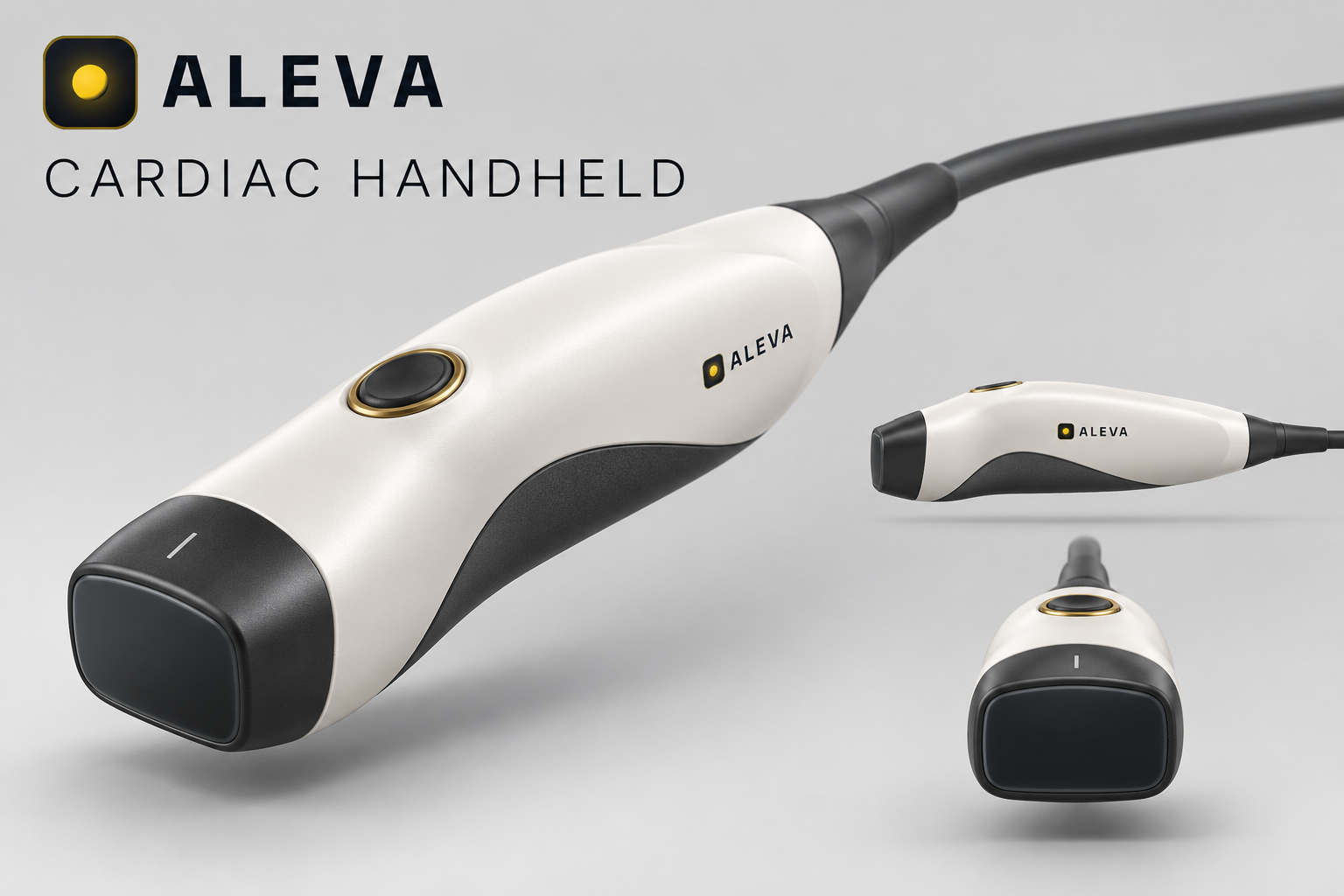
Concept illustration of the ALEVA cardiac handheld probe; final design subject to verification.
Why Parallel Processing Matters
Creating an ultrasound image involves processing signals across multiple receive channels, calculating propagation delays, combining echoes, and reconstructing thousands of image locations. These operations offer substantial opportunities for parallel computation.
ALEVA’s architecture is designed to distribute suitable workloads across GPU processing resources rather than rely exclusively on a fixed-function imaging pipeline.
This approach creates flexibility in how computational resources are allocated: toward image reconstruction, more sophisticated processing, or a balance between image quality and responsiveness.
The objective is not simply to perform the same calculations faster. It is to create room for imaging methods that would otherwise be difficult to accommodate within a compact platform.
An Imaging Platform That Can Evolve
A software-defined architecture allows imaging algorithms to be evaluated, refined, and updated without requiring a complete redesign of the acquisition hardware for every improvement.
ALEVA’s development roadmap includes evaluation of:
GPU-parallel beamforming: reconstructing image locations concurrently from acquired channel data.
Coherent compounding: combining information from multiple transmissions to explore improvements in image consistency and contrast.
Motion-aware processing: addressing the challenges introduced when cardiac tissue moves between acquisitions.
Adaptive reconstruction: investigating methods that adjust signal combination to the characteristics of the received data.
Structure-preserving image enhancement: exploring noise and speckle processing while protecting relevant anatomical boundaries.
These are development directions, not a claim that every method is already available. Each addition must demonstrate its value within the platform’s processing, memory, power, and thermal limits.
Designed Around Cardiac Imaging
The moving heart presents a demanding engineering problem. Image detail matters, but so does preserving the timing and continuity of motion.
ALEVA’s cardiac focus therefore extends beyond producing an attractive still image. The platform is being developed around the relationship between spatial detail, temporal performance, and motion-sensitive processing.
Its enclosure concept pairs a compact cardiac probe head with a sculpted grip, an accessible thumb control, and a flexible cable intended to support comfortable positioning.
The accompanying tablet concept presents a streamlined workspace with a large cardiac imaging viewport, accessible controls, and cine review. A USB-C connection is shown as the proposed physical interface; supported hosts and interface specifications will be announced after verification.
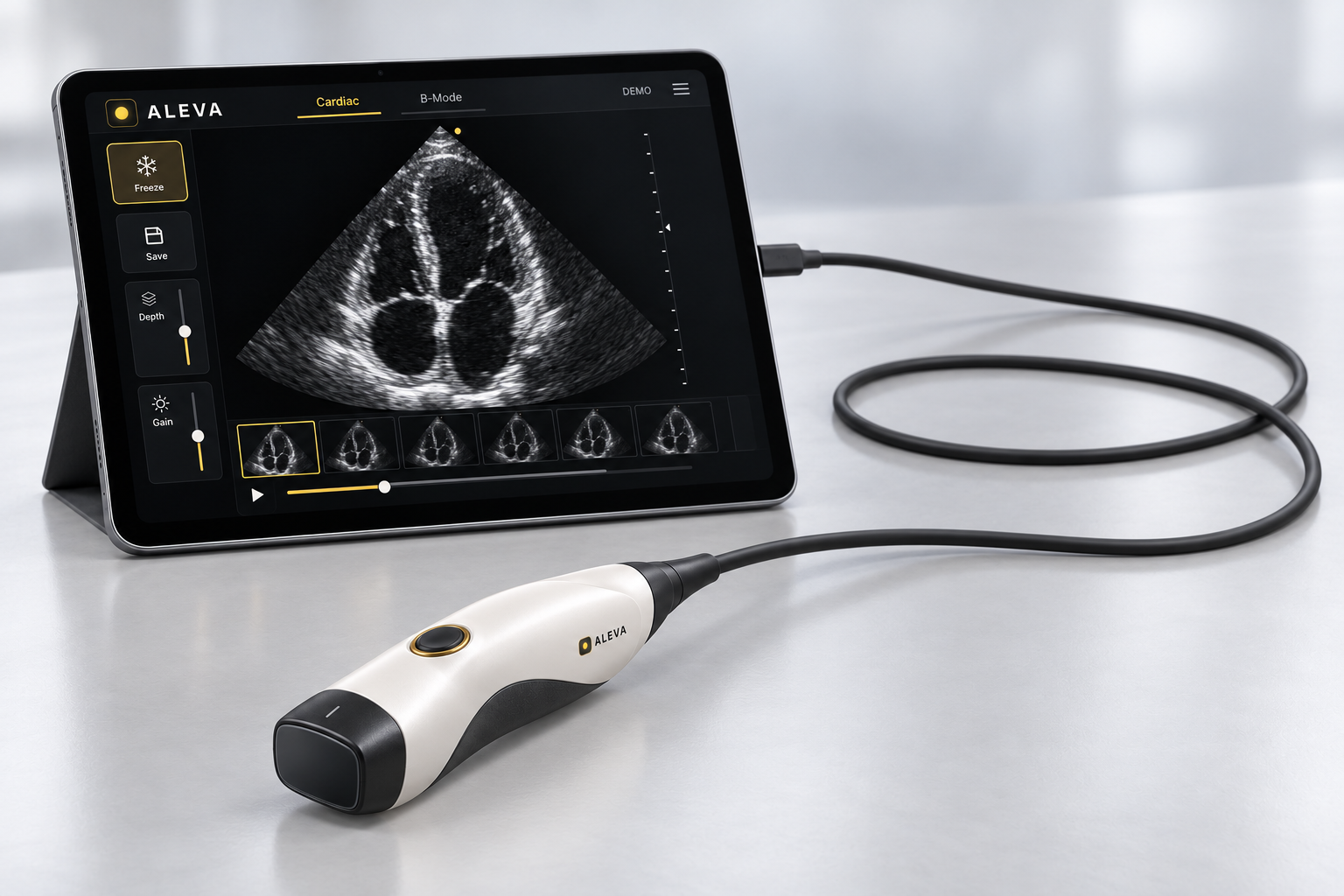
Concept illustration of the probe and proposed tablet interface. The displayed cardiac image is illustrative, not a measured imaging result.
A Longer-Term Approach to Handheld Ultrasound
The central idea behind ALEVA’s platform is straightforward: a compact device should have a path to meaningful improvement after its initial release.
As algorithms advance, a flexible processing architecture can provide opportunities to introduce new reconstruction methods and refine existing imaging workflows. Those improvements remain bounded by the information captured by the hardware—and must be demonstrated through testing.
ALEVA is building toward a handheld platform that combines purposeful industrial design with an adaptable computational foundation.
Coming soon from ALEVA Technologies.
The platform is undergoing engineering testing. Product visuals and the tablet interface are concept illustrations, not measured imaging results. Final specifications, supported configurations, availability, and clinical indications will be announced following the applicable verification, validation, and regulatory processes.