Opinion
The Future of Ultrasound Manufacturing: Where Differentiation Moves Next
Siemens Healthineers recently announced the end of sales of its general-imaging ultrasound systems and a focus on procedural imaging.

Siemens Healthineers ACUSON Origin ultrasound system. Photo and logo: Siemens Healthineers.
Siemens Healthineers recently announced the end of sales of its general-imaging ultrasound systems and a focus on procedural imaging. I think that is a sensible decision. General imaging is becoming a difficult place for a large manufacturer to defend a premium, even when its technology remains strong.
Compared with two decades ago, buyers have a much wider choice of suppliers, including Chinese and Korean manufacturers. My assessment is that, for many routine examinations, the difference in image quality is now less obvious to buyers than the difference in price. That does not make all systems clinically interchangeable. It does make the premium harder to justify.
A large manufacturer has to pay for extensive engineering teams, service networks and a broad product portfolio. Smaller competitors still have to meet safety and regulatory requirements, but they need not carry the same organizational costs. If lower-priced systems meet a customer's routine needs, the larger company's cost structure becomes a problem.
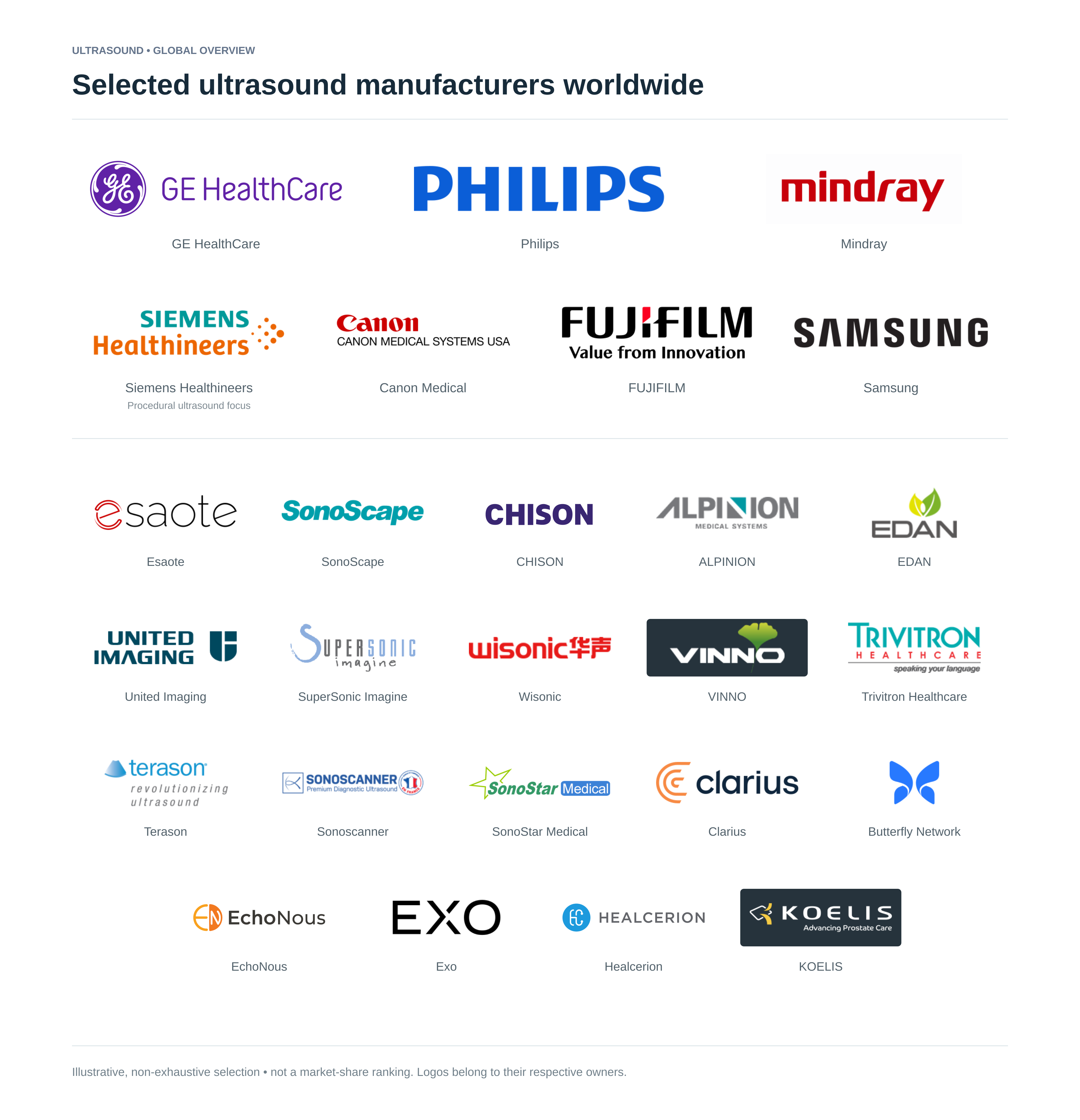
Selected ultrasound manufacturers worldwide: an illustrative, non-exhaustive selection, not a market-share ranking. Logos belong to their respective owners. SuperSonic Imagine logo reproduced from its official 2020 manual; latest graphic identity unverified.
That is why I see a sound business case for concentrating resources on advanced imaging and procedural guidance. Matrix-array transducers and demanding cardiac applications leave more room for engineering that customers can distinguish and may pay more for. This is my interpretation of the economics, not a financial explanation supplied by Siemens.
The hardware helps explain how competition has reached this point. More of the acquisition electronics now comes integrated into components that manufacturers can buy, reducing some of the design work previously needed at board level.
Take Texas Instruments' AFE5932, introduced in 2026. It combines 32 receive channels with gain and filtering functions, 12-bit analog-to-digital conversion at up to 50 MSPS, and digital decimation. TI specifies 17 mW per channel at a 50-MHz ADC clock. That is the component's consumption, not the power budget for a complete probe.
On the transmit side, Japan's ABLIC offers the S-UM5587EF, which integrates 16-channel transmit timing, waveform control, high-voltage drivers and active transmit/receive switches. Fewer separate devices mean fewer external interconnections to design and manage. That can ease noise and coupling problems, including interference between channels. It does not remove the need for careful layout, shielding, power integrity or thermal design.
These components do not build an ultrasound system by themselves. They do let a manufacturer spend less effort assembling the acquisition electronics and more on the transducer, image formation and the clinician's use of the device. I see that as one reason more companies can compete in routine imaging.
Mobile GPUs extend the possibilities. Depending on the architecture, a phone or tablet can take on more beamforming and image processing in software. This gives developers more freedom to change algorithms, but processing speed alone is not enough. Data must reach the processor, move through memory and be handled continuously without overheating. Some systems will still need substantial processing inside the probe. Software also needs validation, and AI functions may run locally or remotely; they do not all require a cloud connection.
For point-of-care ultrasound, the question is what this hardware and software can deliver during an examination. An ICU, operating room, emergency department, ambulance and musculoskeletal practice do not have identical requirements. Making a device small is only part of the job. It has to produce the required images and work reliably within the clinical workflow.
I expect higher-performance handhelds to begin replacing some conventional portable systems in selected applications over the next one to two years. Home use may expand too, within defined regulatory permissions and clinical oversight. The FDA's 2025 authorization of Pulsenmore ES provides a narrow precedent: guided, prescription home image acquisition for clinician assessment of fetal heart rate. It is not permission for unrestricted self-diagnosis.
For manufacturers, I see two worthwhile directions: advanced probes and imaging capabilities that remain technically difficult to reproduce, and high-performance POCUS systems that can take over specific jobs from larger portable equipment. Siemens has chosen to concentrate on procedural imaging. Other companies may choose differently, but they face the same practical question: which part of the system still justifies their engineering effort and the price they need to charge?
Sources for editorial verification
Siemens announcement, 12 October 2026:
https://www.siemens-healthineers.com/en-us/ultrasound/news-stories/procedural-ultrasound
TI AFE5932:
https://www.ti.com/lit/gpn/AFE5932
ABLIC S-UM5587EF:
https://www.ablic.com/en/doc/datasheet/ultrasound_digital_transmit_pulsers/SUM5587EF_E.pdf
TI handheld ultrasound reference design:
https://www.ti.com/lit/ug/tidufa5/tidufa5.pdf
FDA Pulsenmore ES:
https://www.accessdata.fda.gov/cdrh_docs/reviews/DEN240074.pdf
FDA Pulsenmore ES authorization letter, 31 October 2025:
https://www.accessdata.fda.gov/cdrh_docs/pdf24/DEN240074.pdf
Author opinion by Mostafa Taghipour. Mention of Siemens Healthineers does not imply its endorsement of this article or ALEVA.