Ultrasound Engineering
Will Handheld Ultrasound Replace Portable Consoles? Compute Is Only Part of the Answer
A short engineering analysis of probe-versus-host processing, power, data transport and compatibility—without predicting the disappearance of dedicated ultrasound consoles.
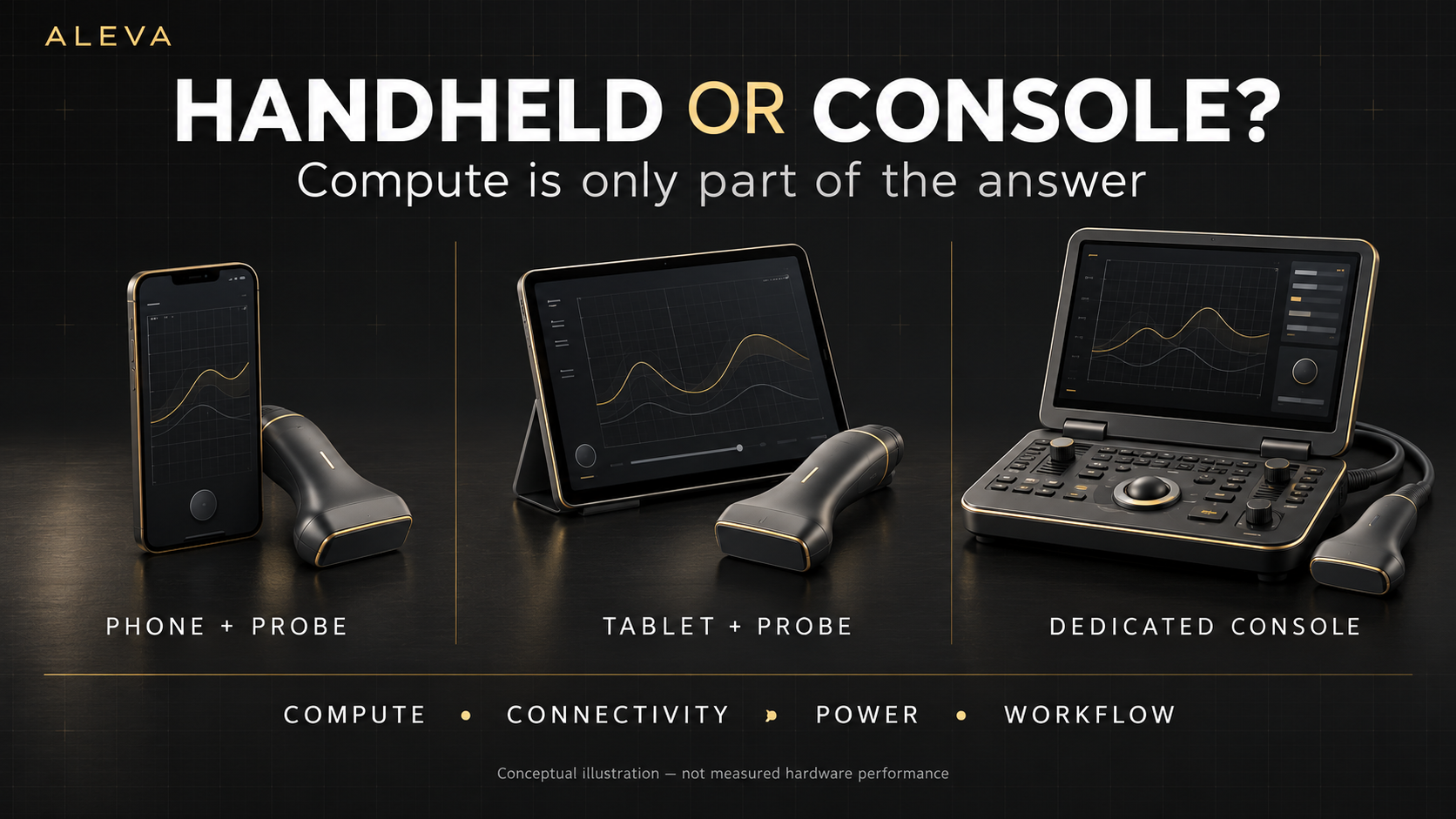
AI-generated conceptual comparison of phone-plus-probe, tablet-plus-probe and dedicated portable-console form factors. Generic imagined devices, not actual ALEVA products; screen traces are illustrative, not ultrasound measurements or hardware-performance evidence.
By ALEVA | California, USA
Faster GPUs in phones, tablets and laptops could make a separate ultrasound computer less necessary for some workflows. That is a plausible engineering hypothesis—not evidence that portable consoles will soon disappear. Handheld ultrasound is itself portable; the useful distinction is between a probe paired with a general-purpose host and a dedicated console.
The change is architectural, not only computational
A probe-plus-mobile-host architecture already exists. GE HealthCare describes the Vscan Air mobile application as providing display and control functions, with images transmitted wirelessly from the probe. This does not establish that its receive beamforming runs on the phone's GPU. [1] More host compute only helps the processing stages actually assigned to that host.
The rest of the scanner does not disappear. TI's TIDA-010269 design guide shows transmit and receive electronics, an FPGA for beamforming, and power circuitry alongside the mobile host. It also identifies compact-enclosure heat and power-conversion efficiency as design challenges. [2] This December 2024 reference is an architectural example, not a newly released chipset or an ALEVA implementation.
Moving computation also moves constraints
For OEM development, we propose comparing three allocations: beamforming mainly in the probe; reconstruction mainly on the host; or a split pipeline with upstream data reduction. These are evaluation options, not descriptions of every commercial handheld.
Keeping more processing in the probe may reduce transport demand but consumes probe power and thermal headroom. Sending channel data to the host can increase algorithm flexibility, while requiring adequate sustained transfer and predictable timing. The decision should follow a measured data-and-power budget, not GPU peak throughput alone.
A replaceable host also creates a compatibility lifecycle. GE publishes verified device/OS combinations and warns that unlisted combinations have not been verified. [3] A newer processor therefore does not, by itself, establish a compatible imaging platform.
Replace a workflow, not a category
Clinical comparisons need equally careful boundaries. A 2025 thoracic study assessed paired videos from 20 patients, recorded by one operator in one setting. [4] Such a design cannot establish universal replacement across examinations, operators and devices. A 2026 technical review and expert consensus likewise emphasizes task-specific selection and the limits of handheld systems relative to comprehensive ultrasound. [5]
Our proposed acceptance test therefore combines image adequacy for the intended task with sustained operation, probe temperature, battery endurance, connection recovery, reporting and host-update compatibility. Larger displays, physical controls and access to multiple probes should be evaluated as workflow requirements—not assumed to be obsolete because reconstruction becomes faster.
Bottom line: more capable hosts may shift some examinations toward handheld and modular systems. The defensible OEM opportunity is deciding what remains in the probe and what can move to a replaceable host. Coexistence with dedicated consoles is our engineering interpretation, not a quantified market forecast or a replacement deadline. No ALEVA benchmark, clinical equivalence or commercial implementation is claimed.
Sources
GE HealthCare. Vscan Air: Probe Description. Rolling manufacturer documentation, reviewed October 18, 2026; display/control architecture, not a disclosure of all processing stages.
Texas Instruments. Handheld Ultrasound Imaging Device Power Supply Reference Design, TIDA-010269, document TIDUFA5, December 2024; Sections 1, 2.1 and 2.2.
GE HealthCare. Vscan Air: Compatible Display Devices. Rolling compatibility guidance, reviewed October 18, 2026.
Halim D. et al. Standard to Handheld: A New Wave in Thoracic Ultrasound and Patient Care—A Direct Comparison of Portable Handheld Against Standard in Thoracic Ultrasound. Medicina 61(2), 313, February 11, 2025. DOI: 10.3390/medicina61020313. Study design checked in the indexed abstract; no universal equivalence claim is drawn from it.
Dietrich C.F. et al. Handheld Ultrasound: Technical Review and International Expert Consensus Recommendations. Diagnostics 16(19), 3215, October 4, 2026. DOI: 10.3390/diagnostics16193215. Narrative technical review and expert consensus—not a systematic review or market forecast.