Insights
Pulse-Inversion Ultrasound: Check Cancellation Before Trusting Harmonic Contrast
Separate residual fundamental leakage from useful harmonic response, with an illustrative cancellation model and a proposed paired-acquisition acceptance test for ultrasound OEM teams.
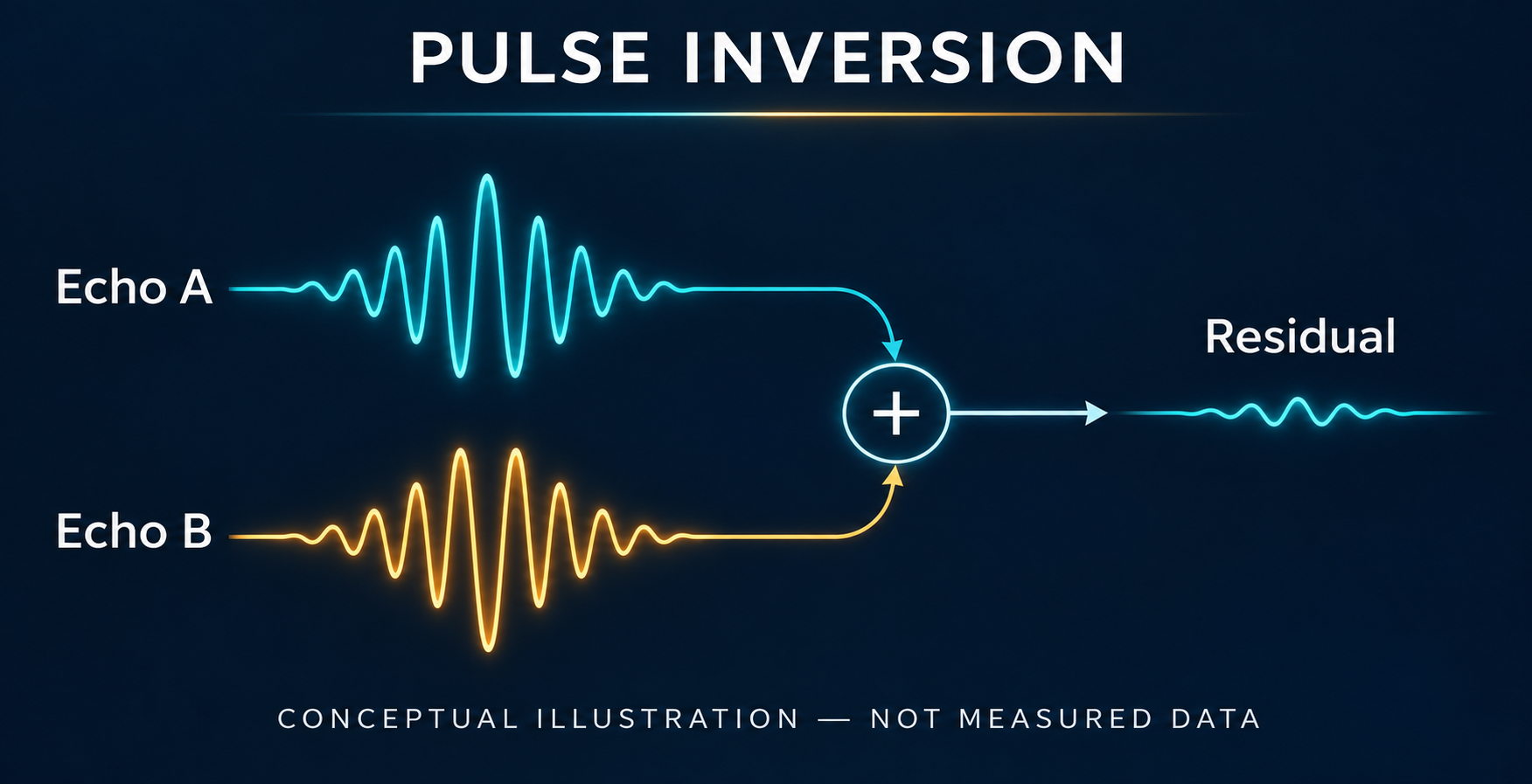
Conceptual illustration of opposite-polarity echoes and a residual after addition. Not measured data, a quantitative simulation, or evidence of hardware performance.
By ALEVA | Orange County, California, USA
Engineering question: How can an OEM team distinguish a useful harmonic signal from imperfect cancellation of the fundamental?
Pulse inversion combines echoes from two opposite-polarity transmissions. Under an idealized, stationary, repeatable acquisition, the linear responses cancel while even-order nonlinear components reinforce. The engineering problem is that a real pair can differ in amplitude, timing, receiver state or tissue position. A residual after addition therefore does not, by itself, prove successful harmonic isolation.
Separate the signal mechanisms
Shen and Li's foundational 2001 study examined transmit waveform, bandwidth and system nonlinearity as sources of harmonic leakage. It also identified the frame-rate and motion trade-offs of pulse inversion. This is established research, not a newly introduced algorithm. For an OEM acceptance test, separate fundamental cancellation from the desired harmonic response and from nonlinear distortion generated by the measurement chain itself. [1]
A useful conceptual check treats the fundamental components as normalized complex phasors: the first is 1 and the second is −(1+ε)exp(jφ). Their sum has residual amplitude |1−(1+ε)exp(jφ)|. Perfect matching gives zero. With a chosen 2% amplitude mismatch and 5° phase mismatch, the residual is approximately 0.0903, or −20.9 dB relative to one fundamental echo. These are calculated illustrative values, not ALEVA measurements or product limits. The model omits propagation, noise, bandwidth, nonlinear generation and decorrelation; it cannot predict clinical image quality.
Make the paired acquisition observable
Our proposed test records both constituent captures as well as their sum. Keep transmit waveform identifiers, polarity, event spacing, receive gain, acquisition start time and processing configuration with the data. Test a stationary reference first, then vary one controlled factor at a time. Measure the residual fundamental band separately from the intended harmonic band, and document the filter bandwidth and amplitude normalization.
Also compare the two individual echoes for clipping and unequal gain. Cancellation after a clipped capture cannot reconstruct the missing waveform. Repeat the check across receive channels and relevant gain settings. When a moving phantom is available, preserve the same acquisition settings while changing motion, so that a loss of cancellation is distinguishable from a configuration change.
Recent research adds choices, not a universal setting
A framework published online on December 11, 2024 in IEEE TUFFC combines pulse-inversion harmonic imaging with motion compensation and angular coherence. Its reported validation supports investigating these mechanisms together; it does not establish equivalent performance on an unrelated OEM platform. Motion estimation itself needs validation when echoes decorrelate. [2]
Shen, Chiu and Chu's 2026 study of phase-encoded multiplane-wave harmonic imaging compares coding matrices and waveform shapes, finding that phase distortion can create decoding artifacts. It was published online on March 30, 2026 and assigned to the November issue. Its reported configuration preference applies to that investigation; adopting a code name alone does not reproduce the result. [3]
The OEM decision
Specify cancellation, usable harmonic response, motion robustness and acquisition throughput as separate acceptance measures. Additional transmissions, compensation and selective compounding can change the timing and processing budget. Retain raw paired data until those trade-offs are understood. A bright harmonic-mode image is a starting observation; a reproducible record of what survives the pairwise sum is the engineering evidence.
This article presents a proposed engineering test approach. It does not claim that ALEVA commercially implements the cited research or that the illustrative calculation validates hardware or clinical performance.
Sources
Shen CC, Li PC. Harmonic leakage and image quality degradation in tissue harmonic imaging. IEEE TUFFC 48(3), 728–736, May 2001. DOI: 10.1109/58.920701.
Mougharbel et al. A unified framework combining coherent compounding, harmonic imaging and angular coherence for simultaneous high-quality B-mode and tissue Doppler in ultrafast echocardiography. IEEE TUFFC, online December 11, 2024; bibliographic title as indexed in PubMed. DOI: 10.1109/TUFFC.2024.3505060.
Shen CC, Chiu CC, Chu YL. Optimization of Ultrasound Phase-Encoded Multiplane Wave Tissue Harmonic Imaging. Ultrasonic Imaging 48(6), 414–424, November 2026; online March 30, 2026. DOI: 10.1177/01617346261436047.