Research
From 8-Channel AFE Cards to 32-Channel Ultrasound Front Ends
A technical overview of how ultrasound receive architectures evolved from modular 8-channel AFE cards toward integrated 32-channel front ends and scalable beamformer systems.
Ultrasound beamformer architecture is shaped long before the image reaches the display. The receive chain must coordinate the probe, analog front end, clock distribution, data links, FPGA or GPU processing, memory movement, and imaging software.
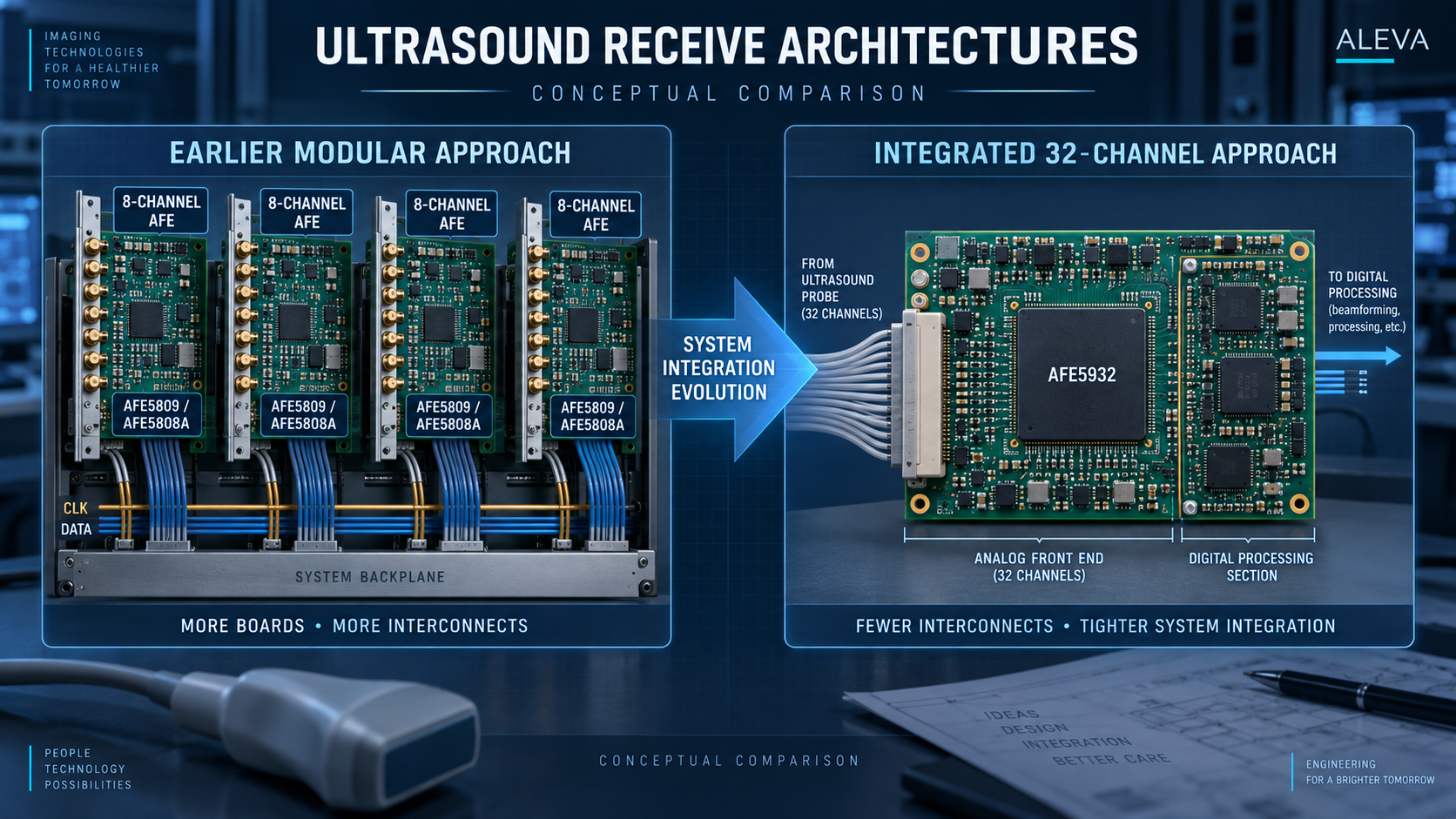
Earlier ultrasound platforms often increased channel count by combining multiple smaller AFE devices or separate receiver cards. Texas Instruments has publicly documented 8-channel ultrasound AFEs such as the AFE5809 and AFE5808A, followed by 16-channel devices including the AFE5818 and AFE58JD16. More recent public devices such as the AFE5932 provide a 32-channel ultrasound AFE architecture.
A conventional 32-channel receive path could be built from four 8-channel sections. That approach can work, but every additional card, connector, and board-to-board interface introduces more design considerations: clock synchronization, power distribution, signal integrity, calibration, thermal management, and high-speed data routing.
The move toward more highly integrated 32-channel AFEs changes the system-level design equation. Instead of distributing the receive chain across several smaller modules, designers can place more of the analog front end closer together on a single board. This can reduce interconnect complexity and create more freedom in mechanical packaging, power planning, and portable-system design.
Integration does not automatically guarantee better image quality. Final performance still depends on the probe, transmit path, receive-chain design, clock quality, dynamic range, beamforming algorithms, FPGA or GPU processing, and software workflow. Channel count is only one part of the architecture.
However, higher integration can create new opportunities for handheld and portable ultrasound systems. Smaller electronics assemblies, fewer interconnect boundaries, and more efficient system partitioning may help engineering teams balance image quality, power consumption, size, manufacturing complexity, and product cost more effectively.
In a conceptual four-device topology, four 32-channel AFE devices could represent 128 AFE input channels at the front-end level. That number should not be described as 128 final imaging channels unless the complete probe, transmit/receive routing, synchronization, and beamforming architecture has been validated.
At ALEVA, we look at these developments from a system perspective. The goal is not simply to select a newer IC, but to integrate the front end, data acquisition, beamforming, embedded software, and mechanical platform into a product architecture that can move from prototype to production.
This article presents a public, conceptual comparison. It does not disclose a customer design, proprietary schematic, internal parameters, or confidential implementation details.
Public references:
TI AFE5809 — https://www.ti.com/product/AFE5809
TI AFE5808A — https://www.ti.com/product/AFE5808A
TI AFE5818 — https://www.ti.com/product/AFE5818
TI AFE58JD16 — https://www.ti.com/lit/ds/symlink/afe58jd16.pdf
TI AFE5932 — https://www.ti.com/product/AFE5932