Ultrasound Engineering
Ultrasound IQ Decimation: Specify the Band, Not Just the Rate
A source-led ultrasound OEM review of RF-to-IQ passband, sample representation and decimation acceptance, with reproducible payload arithmetic and explicit limits.
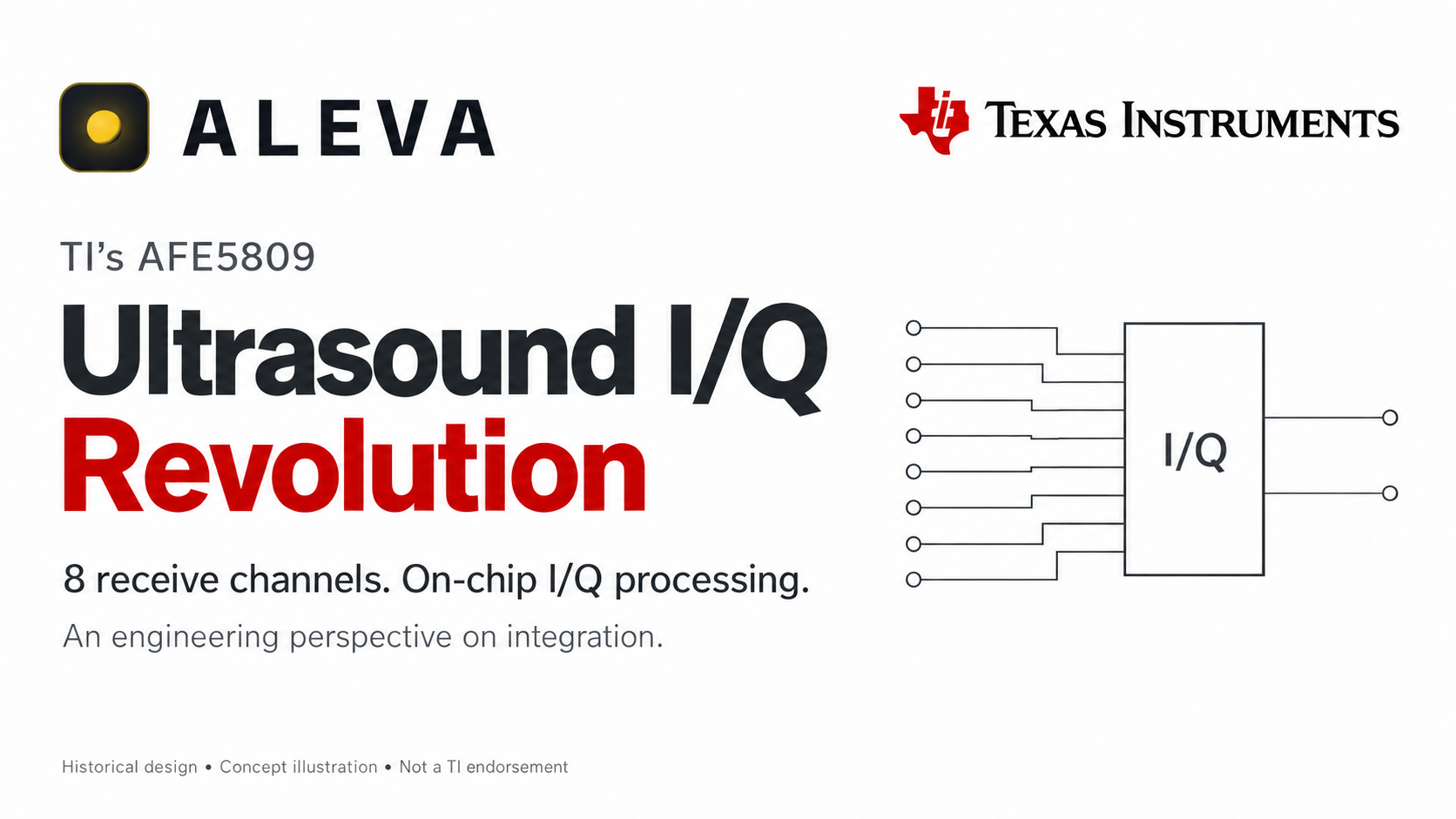
Conceptual illustration of RF-to-IQ band selection and lower-rate I/Q streams. AI-generated; not a measured waveform, filter response or device specification. The artwork does not encode a numerical phase or sampling relationship.
By ALEVA | California, USA | October 21, 2026
Engineering question: What must an ultrasound OEM team preserve when replacing an RF interface with a lower-rate IQ stream?
Define the signal before reducing its rate
IQ conversion is a processing decision, not simply a smaller file format. A receiver shifts a selected RF band toward baseband, filters it and reduces the sample rate. The output therefore needs a declared demodulation frequency, usable passband and filter response, together with the sample rate. An IQ label alone does not tell a downstream algorithm which frequencies remain available.
A peer-reviewed 2024 study by Liu and colleagues compared spectral quantitative-ultrasound processing using original RF, derived IQ and reconstructed RF. Its results support direct IQ processing for the tested analysis; they do not prove equivalence for every reconstruction or imaging mode. The paper also identifies filtering during conversion as a possible source of artifacts. [1]
Count both components
Consider an illustrative interface calculation, not a device specification. Assume one channel exports real RF at 24 million samples per second, packed at 12 bits per sample. Its payload is 24 × 12 = 288 Mbit/s. After fourfold decimation, assume IQ consists of 6 million complex samples per second, with 16 bits for I and 16 bits for Q. That payload is 6 × (16 + 16) = 192 Mbit/s: a 1.5-fold reduction, not fourfold.
These assumptions omit packet headers, padding, timestamps and line coding. Different packing changes the answer. More output bits do not automatically establish more analog information. TI's AFE5809 documentation provides a historical example of integrated demodulation and decimation; the reviewed PDF is SLOS738E, revised August 2015, not a new component announcement. [2]
Filtering and array sampling are separate checks
In the illustrative 6-MSPS complex stream, the Nyquist interval spans −3 to +3 MHz. If the required baseband extends to ±2 MHz, do not treat the remaining interval as extra guaranteed signal bandwidth: specify the transition region and required rejection. Without adequate filtering, a component at +4 MHz aliases to −2 MHz because 4 − 6 = −2 MHz. This arithmetic describes sampling, not a measured artifact level.
A separate 2026 IUS accepted-poster abstract discusses how demodulation frequency and bandwidth can affect spatial aliasing in ultrafast intracardiac imaging. We reviewed the official abstract, not a full journal paper or independently replicated experiment. Its narrow relevance is to test frequency selection together with the array and steering configuration; it is not evidence of ALEVA performance. [3]
A proposed acceptance record
For a candidate RF-to-IQ interface, our proposed engineering review is to preserve an RF reference capture, identify the mixer convention and oscillator phase reference, and version the filter coefficients, scaling, rounding, saturation and sample timing. Record whether data are channel-level or already beamformed. Align reference and candidate timing before comparing complex amplitude, phase and the required downstream result.
Test signals inside the retained band and outside it, including the transition region. Repeat for the intended depth, aperture and steering conditions. Define acceptable error before inspecting the comparison, and evaluate burst and sustained transport separately. This is a proposed method, not a completed test report or a universal acceptance threshold.
The OEM/ODM decision
Lower-rate IQ can reduce transport and processing demands, but its value depends on the information retained for the intended task. Agree the frequency band, timing convention, data representation and reproducible acceptance evidence before freezing the interface. Related: OEM engine integration and FPGA/GPU architecture.
Sources and scope
Liu et al., Spectral-based quantitative ultrasound imaging-processing RF vs IQ data. Ultrasonic Imaging 46(2), 75–89; online February 6, 2024. Peer-reviewed research.
Texas Instruments AFE5809 datasheet, SLOS738E, revised August 2015; manufacturer reference.
IUS 2026 paper 7981, IQ Demodulation as a Spatial Frequency Selector in Ultrafast ICE Imaging: Implications for Aliasing. Official accepted-poster abstract; full-paper publication and DOI not established in this review.
Sources checked October 21, 2026. Searches prioritized 2025–2026; older sources retain their actual dates. The numerical example is reproducible payload/sampling arithmetic with explicit assumptions. No named-component use, hardware measurement or clinical result is claimed for ALEVA.