Insights
Ultrasound Golay Codes: Verify Both Acquisitions Before Claiming Sidelobe Cancellation
Verify Golay-pair acquisition consistency with an exact four-chip gain-mismatch calculation, a reproducible educational figure and a proposed ultrasound OEM acceptance record.
ALEVA · Orange County, California, USA
What must an ultrasound OEM verify before treating a Golay-coded acquisition as free of code-related range sidelobes? The complementary-code identity is exact, but it applies to a pair of consistently acquired and decoded signals. A useful acceptance test must examine both acquisitions and their combination.
The cancellation belongs to the pair
For two real binary sequences A and B of length N, let RA[k] and RB[k] be their aperiodic autocorrelations. A complementary pair satisfies RA[k] + RB[k] = 2Nδ[k]. Each sequence may have substantial correlation sidelobes; their sum cancels those code sidelobes. Gran and colleagues describe the two-transmission decoding process and its sensitivity to target motion in a peer-reviewed 2008 ultrasound study. This is established research, not a new 2026 discovery. [1]
Under a shared linear, time-invariant response h, code-domain decoding gives h ∗ (RA + RB) = 2Nh. The remaining response is h, not an infinitely narrow acoustic pulse. Probe bandwidth, the chip waveform and the receive chain still determine the physical response. A claim about code cancellation therefore does not establish unlimited axial resolution or the absence of all image artifacts.
An exact four-chip example
Consider A = [1, 1, 1, −1] and B = [1, 1, −1, 1]. For nonnegative lags k = 0, 1, 2, 3, the autocorrelations are RA = [4, 1, 0, −1] and RB = [4, −1, 0, 1]. Their sum is [8, 0, 0, 0]. Negative lags are symmetric.
Now assume the second acquisition has a uniform amplitude factor 1 + ε while both decoders remain unchanged. This deliberately simplified, noiseless model produces RA + (1 + ε)RB = [8 + 4ε, −ε, 0, ε]. The peak nonzero-lag magnitude relative to the central peak is |ε| / |8 + 4ε|.
For ε = 0.10, the residual is 0.1 / 8.4, or approximately −38.5 dB using 20 log10 of the amplitude ratio. For ε = 0.20, it is approximately −32.9 dB. These are exact calculations for this four-chip example, not measurements of ALEVA hardware, clinical performance claims or recommended acceptance limits. Perfect cancellation at ε = 0 means mathematical zero in this model, not an experimentally measurable noise floor.
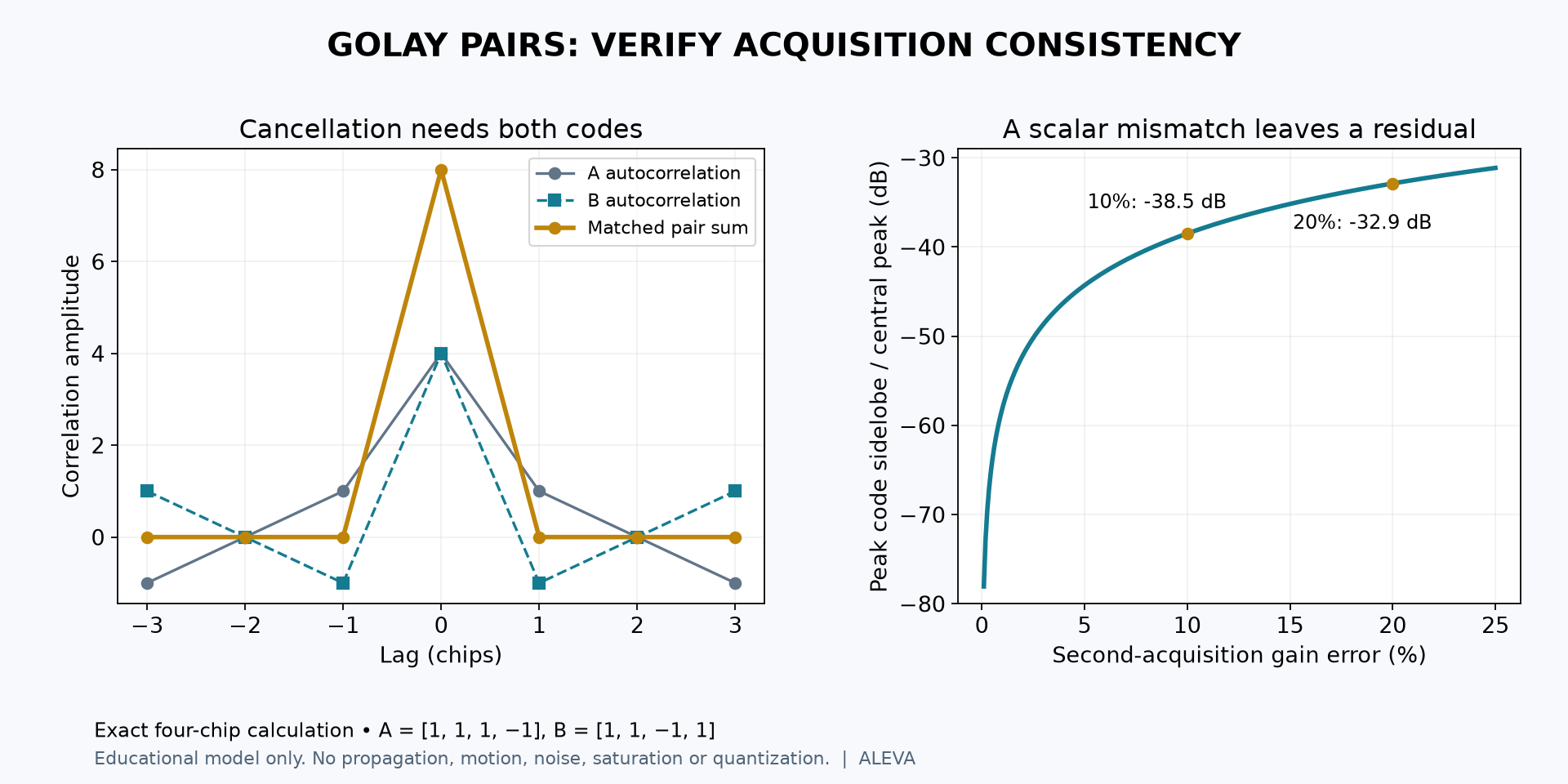
Figure: reproducible educational calculation of four-chip Golay decoding and scalar gain mismatch. No acoustic propagation, motion, electronic noise, saturation or quantization is simulated.
Separate gain mismatch from motion and waveform change
A scalar correction can compensate a known scalar gain difference in this model. It cannot generally restore cancellation when the second echo changes shape or shifts in time. With different responses hA and hB, the decoded sum becomes hA ∗ RA + hB ∗ RB; the shared-response simplification no longer follows. This distinction is the engineering reason to vary gain, timing and motion independently during verification.
Practical coded-excitation design must also consider attenuation, dynamic focusing and nonlinear propagation. Chiao and Hao discuss these implementation effects in their peer-reviewed 2005 system-development paper. Its conclusions should be read within the stated imaging configurations rather than used as a universal performance guarantee. [2]
A proposed OEM verification record
Preserve acquisition identity. Record code ID, pair ID, transmit time, gain state, channel mapping, decoder revision and both raw acquisitions. Reject incomplete pairs explicitly.
Verify the digital identity first. Reproduce the autocorrelations and zero-lag alignment with known sequences. Test reversed codes, swapped labels, a missing member and an intentional gain mismatch.
Characterize the physical response. Measure a suitable isolated target across the agreed depth and operating range. Define the mainlobe exclusion region and normalization before reporting peak or integrated sidelobe metrics.
Stress pair consistency. Vary inter-transmit delay, controlled target motion and gain state separately. Keep uncompressed and individually decoded signals so a failure can be localized.
Record the complete cost. Measure valid combined-output rate, buffering, latency and acoustic output under the actual sequence. Two transmissions per pair consume acquisition time; the effect on frame rate depends on the full schedule.
This is a proposed engineering workflow, not a published standard or a description of a confidential customer implementation. Acceptance thresholds must follow the intended task and measured repeatability.
New methods change the validation question
The publisher abstract for Golay-Net, published in Ultrasonics, volume 159, March 2026, describes a learned single-shot approach intended to avoid the conventional pair-acquisition cost. Only the public abstract was reviewed here; no numerical performance claim is adopted. [3] For an OEM evaluating such a method, the proposed additional checks are independent test data, unfamiliar targets and acquisition conditions, and comparison with a recorded two-shot reference. A learned output needs its own evidence; the two-code algebra alone does not validate it.
The OEM decision is whether the complete acquisition and decoding system delivers the required response under the expected variations. Discuss that boundary alongside beamformer integration and probe development, before treating a code family as a finished imaging capability.
Sources and scope
Gran F, Udesen J, Nielsen MB, Jensen JA. Coded Ultrasound for Blood Flow Estimation Using Subband Processing. IEEE TUFFC, 55(10), 2211–2220, October 2008. Peer-reviewed. DOI: 10.1109/TUFFC.920. Public university-hosted paper.
Chiao RY, Hao X. Coded excitation for diagnostic ultrasound: a system developer's perspective. IEEE TUFFC, 52(2), 160–170, February 2005. Peer-reviewed; public abstract reviewed. DOI: 10.1109/TUFFC.2005.1406543.
Golay-Net: Deep learning-based Golay coded excitation for ultrasound imaging. Ultrasonics, 159, 107881, March 2026. Journal article; public publisher abstract reviewed, full text not assessed. DOI: 10.1016/j.ultras.2025.107881.
No preprint is used. The four-chip calculation and proposed acceptance workflow are original educational analysis.